

Handwriting Sheets and Dotted Name Cards Do More Harm Than Good! [Listen Along 🔊]
My SECOND Article Of The Month, All About Handwriting. You Can Listen Along To This Article.

Hey PLAY People,
Just a quick reminder, you can listen to this article! Find the play button at the top of the article and get your provision hands-free!
Enjoy!
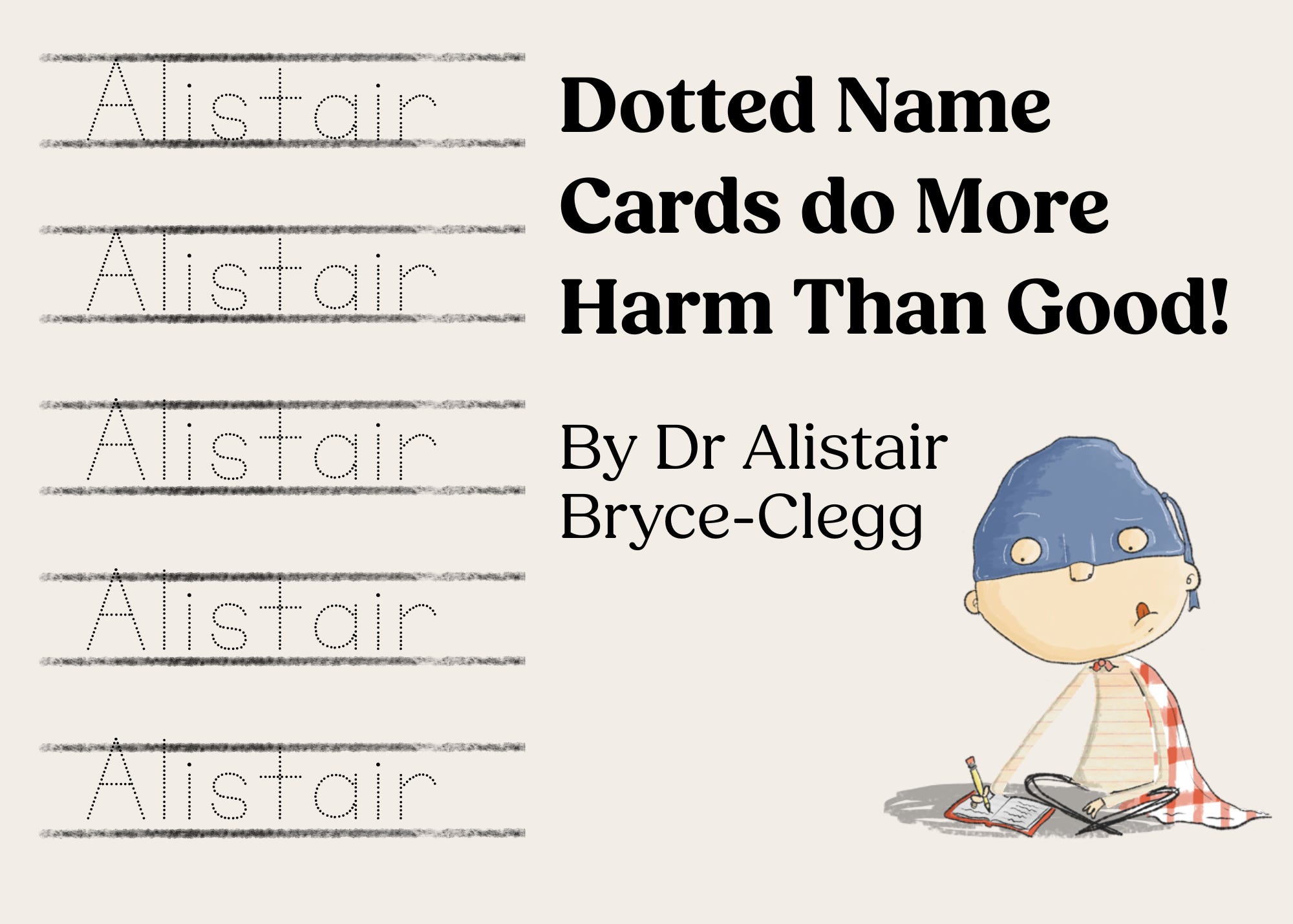
Handwriting Sheets and Dotted Name Cards Do More Harm Than Good!
By Dr Alistair Bryce-Clegg
We have all probably done it, are doing it or have been told to do it! The dotted name card and/or the photocopied letter formation sheets.
But not only do they not work, they may be doing more harm than good!
Why do we do it?..
Well, on the surface, they look purposeful. They produce neat rows of letters or names, they’re easy to collect as evidence, and they give the impression of progress.
But the research indicates that handwriting practice sheets and name cards are not the best way to help children learn to write. In fact, they can hold children back.
Development Comes Before Writing
Children need strong bodies before they can control small movements like handwriting. Core muscles, shoulders, arms and fingers all play a role. Without these, trying to control a pencil for small, precise letters is exhausting.
Occupational therapists often talk about the importance of ‘proximal stability for distal control’. This means strong, big muscles are needed before small muscles can work properly. Research into early motor development (Cameron et al., 2012) shows a clear link between physical development and later literacy outcomes.
Wyse & Goswami (2008) warn that introducing formal writing instruction too early can actually embed poor habits, because children compensate with awkward grips and posture. This slows progress rather than speeding it up.
Cognitive Load and Working Memory
When a child is asked to copy or trace letters, they are trying to manage several things at once -
pencil grip
posture
letter size
direction
pressure
linking shape to sound.
Cognitive load theory (Sweller, 1994) explains that when too many demands are placed on working memory, learning breaks down. Instead of gaining real understanding, children fall back on surface strategies. In this case, that usually means just rote copying.
The EEF (2018) highlight that copying activities can give the illusion of progress without deep learning. A page of neat letters is not the same as a child who can independently form letters in meaningful writing.
The Importance of Meaning
Children learn best when writing is meaningful. Research on motivation and literacy (Guthrie & Wigfield, 2000) shows that children are far more engaged when they see purpose in their work.
A list as part of role play , a label for a model, or a sign for a den all make sense to a child. Rows of repeated letters do not.
The Cambridge Primary Review (Alexander, 2010) highlights that early education must value meaning and motivation over appearance. When writing is reduced to neatness and compliance, children lose the chance to see themselves as writers.
The Problem of Habits
When children practise handwriting before they are ready, they often form letters incorrectly, grip too tightly, or twist their posture. Studies of handwriting development (Feder & Majnemer, 2007) show that early incorrect habits can be very resistant to change.
So practice sheets and name cards don’t just fail to help, they can actively cause problems that teachers then have to spend years trying to correct.
Early Writing Is a Journey
Marie Clay’s classic work on emergent literacy (1975) demonstrated that children’s early writing goes through predictable stages: scribbles, mock letters, invented spellings, and eventually conventional writing. Each stage is important.
Handwriting sheets and name cards expect children to jump straight to the end point, uniform, conventional letters, without moving through the earlier stages. This interrupts the natural developmental pathway and risks making children anxious about writing.
Better Alternatives
The research is consistent. Instead of handwriting sheets and name cards, children need:
Large-scale mark making: Strengthening gross motor skills with paint, chalk, sand and water
Multi-sensory practice: Using dough, foam, or loose parts to form letters
Authentic purpose: Writing that matters to the child
Adult modelling: Shared writing and talk that link sound, movement and meaning
Developmental readiness: Waiting until children’s bodies and brains are prepared for fine handwriting
Handwriting practice sheets and name cards are popular because they look like evidence. But the research is clear. They don’t help children to learn to write. They skip developmental stages, overload working memory, strip away meaning, and can embed poor habits.
If we want children to become confident writers, we need to focus on developmentally appropriate practice which is movement, play, interaction and purpose.
That’s not just my opinion — it’s what the science tells us.
Alistair.
Remember! If you enjoyed this article and want to explore the topic of handwriting in more depth, check out this month’s subscriber training all about name writing. Find it HERE.
Thank goodness someone is talking some sense. I wish I had a mini Alistair in my pocket so that every time SLT came to talk to me about handwriting practice linked to The Writing Framework, he could tell them about the importance of being physically ready to write. I wittered on so much to the OFSTED inspector that he literally backed away from me 😜